
AI for human-centred support · OPMC 2026
PinkPulse AI
Helping people find the right support, with the right boundaries.
PinkPulse AI is an AI-assisted resource navigation concept developed by Team Pink Pathway at Yorkville University for the 2026 Ontario Project Management Competition. The solution connects conversational AI with approved survivorship resources, human oversight, and structured project delivery.
Project
PinkPulse AI
Role
Stakeholder & Communications Lead
Product and delivery planning contributor
Team
Pink Pathway · Yorkville University
Context
Ontario Project Management Competition 2026
The problem
Finding support should not be another challenge.
People navigating breast cancer awareness, treatment preparation, recovery and survivorship may need information about services, assistance programs and application procedures. Relevant information can be spread across pages, documents and support channels, creating information fatigue and uncertainty about the next step.
Person seeking support
- · Needs relevant information
- · Wants clear next steps
- · May feel overwhelmed by complicated navigation
Organization providing support
- · Manages repeated enquiries
- · Maintains program information
- · Needs a consistent, trustworthy communication process
The opportunity was not to replace human care. It was to make trusted information easier to reach.
The solution
A more useful way to navigate support.
PinkPulse was designed around natural-language questions, approved resource retrieval, clear links, empathetic nonclinical communication and escalation to human support when needed.
Illustrative interaction · not a live service
Question
Where can I find information about the Care KIT! program?
Conceptual response
Illustrative response: Care KIT! is an approved support resource. The next step would be to open the organization-provided program information and review its eligibility or application details.
Technical approach
AI grounded in trusted information.
The team presentation described Google Vertex AI, Gemini 2.5 Flash, Retrieval-Augmented Generation, approved PDFs/FAQs/blogs/URLs, Cloud Firestore and a JavaScript website integration concept.
This is a reconstruction of the documented team architecture, not a claim that every component was independently deployed by Amir. RAG can improve grounding; it does not make hallucinations impossible.
PDFs, FAQs, blogs and URLs define the intended knowledge boundary.
Responsible AI
Knowing when not to answer is part of the design.
01
Approved sources
Curated nonprofit resources instead of unrestricted medical information.
02
Nonclinical purpose
Education and resource navigation, not diagnosis or treatment decisions.
03
Privacy by design
The product scope excludes personal medical or sensitive information.
04
Human escalation
Sensitive, uncertain and unsupported situations move toward human support.
“Which program can help me find support?”
Route: approved resource lookup
“What medication should I take?”
Route: do not provide treatment advice; direct to an appropriate healthcare professional
Design illustration, not a validated clinical safety test.
My contribution
Connecting the idea to a deliverable plan.
The final presentation identifies Amir as Stakeholder & Communications Lead. The broader contribution covered product scope, workflow analysis, MVP planning, WBS, Gantt scheduling, cost modelling, stakeholder planning, testing strategy and KPI definition.
Product & workflow
- · Problem framing
- · Workflow analysis
- · MVP scope contribution
- · AI-assisted routing concept at product level
Project delivery
- · Work Breakdown Structure
- · Gantt scheduling
- · Delivery dependencies
- · Cost modelling
Stakeholders & communication
- · Stakeholder planning
- · Communication approach
- · Project-participant coordination
- · Organizational and human needs
Validation & measurement
- · Testing strategy
- · KPI framework
- · Success criteria
- · Responsible AI considerations
My contribution was helping connect a meaningful problem and an AI product concept to the scope, stakeholders, delivery plan, and measures needed to evaluate it.
Project execution
From concept to execution planning.
The delivery framing combined Agile and PMBOK-based thinking. The sequence below describes the proposed project approach, not a claim that every milestone was completed.
Delivery artifacts
What made the concept executable.
Planning artifacts gave the concept a way to be challenged, scheduled and evaluated. Select one to inspect its purpose.
ARTIFACT 01 / 06
WBS
Shows how the proposed solution was broken into manageable work packages.
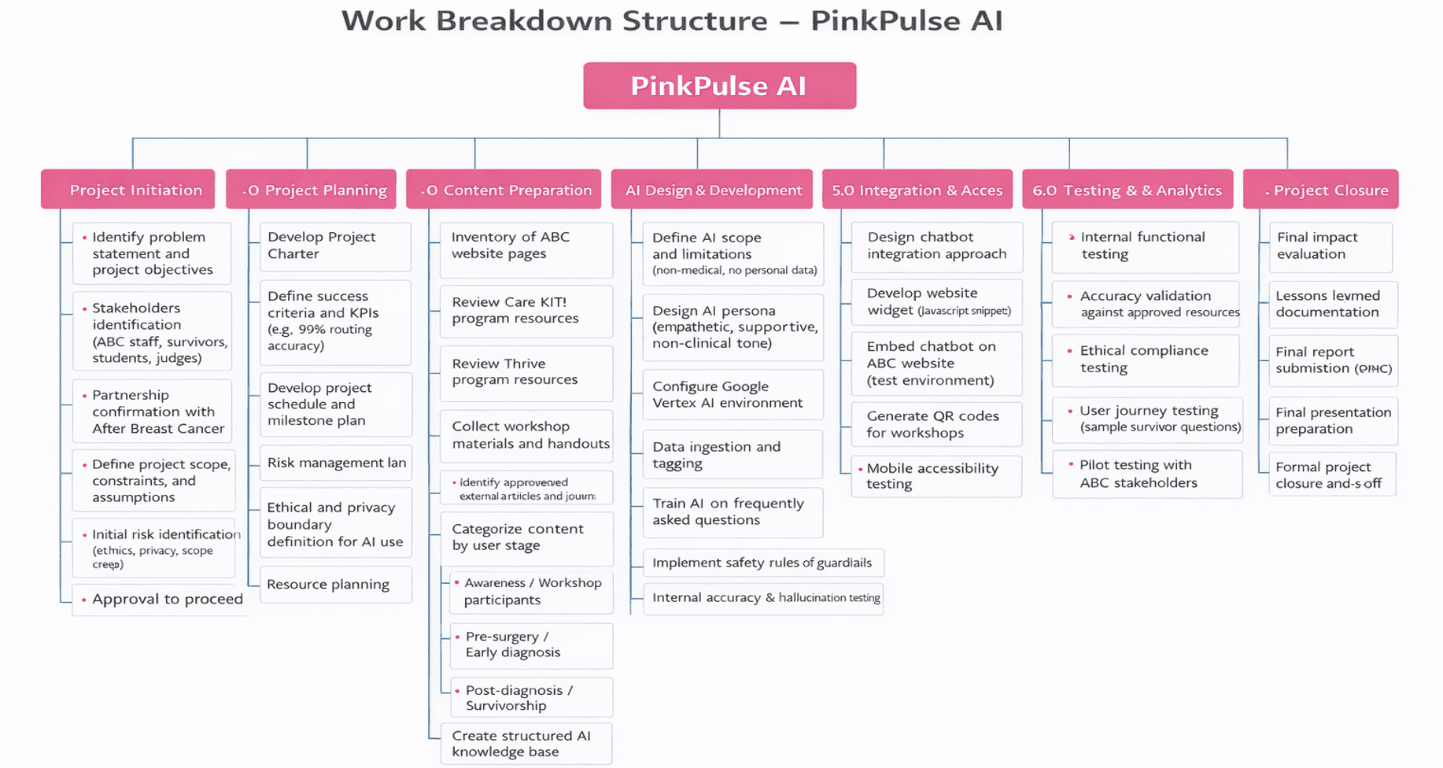
Source visual supplied from the 2026 competition presentation.
Project measurement
Clear targets. Clear evidence.
First place
Verified team competition result.
90%
Target routing accuracy specified in the presentation.
CAD $420
Infrastructure budget described in the presentation.
50%
Proposed administrative burden reduction target.
91%
Beta routing accuracy reported by the team; not independently verified.
~35%
Pilot inquiry reduction reported by the team; not an audited savings result.
1.8s
Average response time reported in the team KPI slide.
4.3 / 5
Overall satisfaction score reported from beta / pilot feedback.
The team materials describe these as targets or reported beta / pilot figures. They do not establish clinical validation, regulatory approval, proven administrative savings, or production-wide healthcare deployment.
The takeaway
Responsible AI starts before the model responds.
PinkPulse reinforced something I value in product development: technology has to fit the people and the process around it.
An intelligent response is not enough if the information is unreliable, the next step is unclear, or nobody is accountable when the system reaches its limits.
Product value
Delivery feasibility
Human trust
The achievement
One team. One meaningful challenge. First place.
Team Pink Pathway represented Yorkville University at OPMC 2026. The integrated result belongs to the team.