
FINTECH · AI RETAIL · PRODUCT STRATEGY · NOVEMBER 2024
GoBuy
AI-powered self-checkout concept
A faster way to shop.
A smarter way to run retail.
GoBuy is a mobile-first self-checkout concept developed during Innovation FinTech Weekend 2024. It explores how product recognition, digital payments, QR-based purchase verification, and retail analytics could reduce checkout friction while creating a more connected in-store shopping experience.
GoBuy
FinTech · Retail Technology
Product Strategist & Team Member
Hackathon product concept
Innovation FinTech Weekend 2024
Discovery · Monetization · Solution design
Recognized item
House blend coffee
250 g · Confirm match
$28.40
Illustrative product interface · reconstructed from the 2024 concept
THE BUSINESS PROBLEM
Why should buying something still require waiting in line?
The opportunity is to explore whether a mobile-first purchasing workflow can improve convenience without creating unacceptable operational or security risks.
CUSTOMER
Less friction at the final stage
- Waiting and capacity at checkout
- Repeated handling and scanning
- Interrupted shopping experience
RETAILER
More visible operations
- Staffing and checkout constraints
- Inventory and loss visibility
- Fragmented customer information
THE GOBUY PRODUCT VISION
Turn a customer's smartphone into a self-checkout experience.
Customers enter a participating store, scan products as they browse, review a digital cart, pay electronically, and present a purchase-verification QR code at exit. Retailers receive a proposal for aggregated operational and demand insight—not a promise of proven results.
Frictionless shopping
Reduce dependence on queues through mobile scanning and digital payment.
Verified transactions
Connect a completed purchase, valid receipt, and exit-verification process.
Retail intelligence
Use relevant transaction and product information to support better decisions.
CORE USER JOURNEY · INTERACTIVE
From store entry to verified exit.
Conceptual customer journey · designed for the November 2024 GoBuy proposal.
Scan the participating store QR code.
System responsibility
The session is associated with the correct location.
Design consideration
Store identity and expired-code handling must be explicit.
PROPOSED TECHNICAL ARCHITECTURE
The systems behind a scan-and-go experience.
Proposed solution architecture · not an implemented or deployed technology stack.
Customer application
Session entry, recognition, cart, payment, verification
Product identification
Barcode lookup and proposed image-based candidates
Product catalogue
Authoritative identifiers, prices, and availability
Cart and order service
Cart updates, totals, order and transaction status
Payment provider
Authorization, confirmation, failure handling
Verification & analytics
Receipt validation, exit status, operational reporting
Mobile client → Product identification → Catalogue → Cart / Order → Payment confirmation → Verification credential
Image recognition is not confirmed product identity. Cart creation is not payment. Payment initiation is not confirmation. A receipt QR requires server-side validation, and retailer POS or inventory systems may need separate reconciliation.
AI PRODUCT RECOGNITION · EXCEPTION DESIGN
What happens when the AI cannot identify a product?
Image captured → Candidate recognition → Catalogue match → User confirmation → Cart update. Human confirmation and explicit fallbacks are part of the product design.
Low confidence
Show alternatives or request a barcode scan.
Similar products
Confirm size, packaging, and product variant.
Missing catalogue item
Use a controlled fallback; never add an unverified item.
Repeated scanning
Prevent accidental quantity increases.
Incorrect price
Obtain price from the authoritative retail system.
Camera failure
Offer an appropriate non-camera alternative where supported.
PAYMENT & EXIT VERIFICATION
Designing trust into a faster checkout.
Proposed safeguards
Server-side payment confirmation
Unique transaction references
Idempotent payment initiation
Time-limited credentials
Receipt validation
Clear escalation and reconciliation
These are system-design considerations a production implementation would need to resolve. They were not built, tested, certified, or deployed by the hackathon concept.
PRODUCT REQUIREMENTS
From product vision to testable system behaviour.
Illustrative requirements and acceptance criteria · reconstructed from the GoBuy concept.
Start a shopping session
As a customer, I want to start a session at a participating store so scanned products are associated with the correct location.
Acceptance criteria: Valid store QR identifies a location; invalid or expired codes produce a clear error.
MVP PRIORITIZATION & COMMERCIAL STRATEGY
What would we build first?
A barcode-first MVP could reduce technical and operational risk before adding image recognition.
Core checkout MVP
Store entry · barcode identification · cart · payment · verification
Intelligent experience
Image recognition · matching · discovery · analytics
Retail platform
Multi-location support · inventory integrations · merchant reporting
Transaction revenue
A fee linked to eligible completed transactions; validate merchant economics and refunds.
Retailer subscription
Recurring value-added merchant capabilities; validate willingness to pay.
Supplier partnerships
Promotional opportunities; validate relevance and incentives.
Retail intelligence
Operational insight without treating individual customer information as a product.
RETAIL INTELLIGENCE
Beyond checkout: understanding retail demand.
Illustrative KPI framework · no historical production data.
Checkout completion rate
Supports a defined product or operational decision.
Median checkout duration
Supports a defined product or operational decision.
Recognition fallback rate
Supports a defined product or operational decision.
Payment failure rate
Supports a defined product or operational decision.
Receipt verification failures
Supports a defined product or operational decision.
Retailer adoption
Supports a defined product or operational decision.
Repeat usage
Supports a defined product or operational decision.
Product demand trends
Supports a defined product or operational decision.
MY CONTRIBUTION
My role in shaping GoBuy.
Product Strategist & Team Member · Innovation FinTech Weekend
Product concept
Defined the product opportunity and value proposition for customers and retailers.
Customer journey
Helped define the essential experience: Scan → Cart → Pay → Exit.
Monetization strategy
Developed proposed transaction-fee, partnership, advertising, and subscription hypotheses.
Pitch and positioning
Supported the commercial narrative under hackathon time constraints.
Innovation FinTech Weekend · November 2024
HACKATHON EXPERIENCE
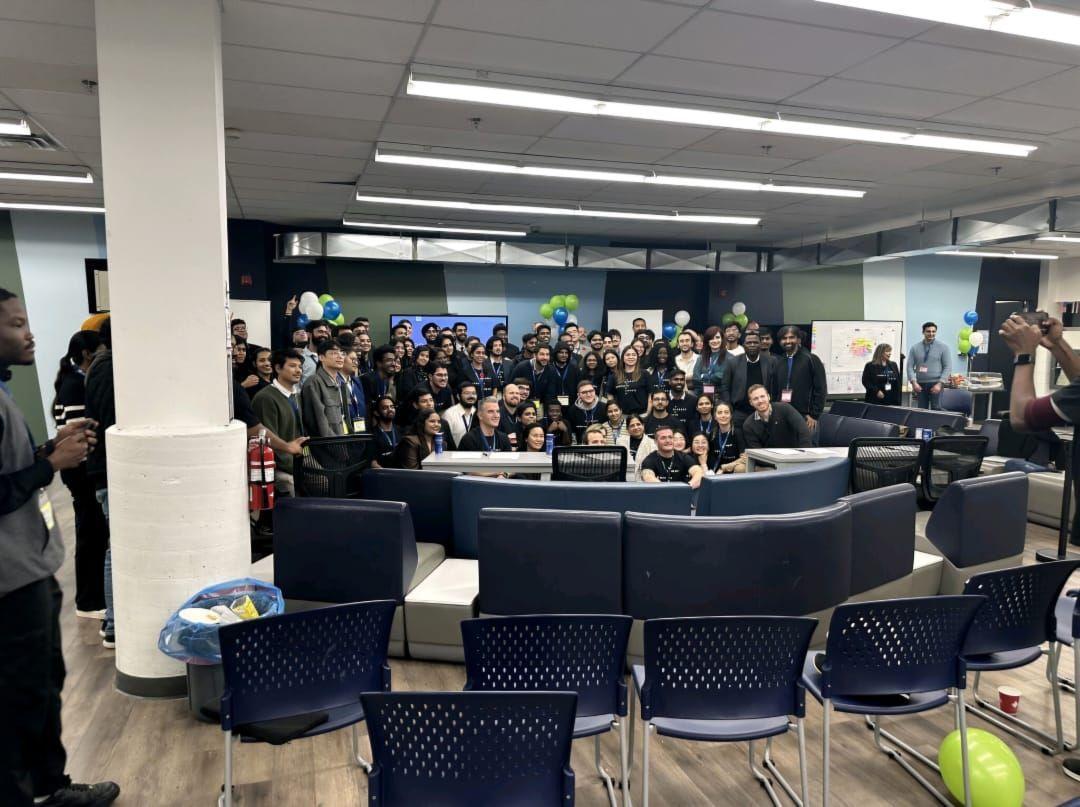
Developed during Innovation FinTech Weekend 2024.
The event produced a structured FinTech product concept with a customer journey, commercial model, and clear positioning for further development. This photograph is evidence of participation and context—not proof of a production application or completed integration.
OUTCOME & LEARNINGS
A product concept designed around a real retail problem.
A seamless experience depends on more than a simple interface. It requires clear system states, accurate product information, reliable payment confirmation, operational safeguards, and merchant adoption.
“GoBuy reinforced how I approach product development: start with the user problem, make the journey clear, test the business logic, and design around real operational constraints.”
CONTINUE EXPLORING