
Digital commerce · Customer experience · Software delivery

Atrbar digital commerce case study
A storefront is only the visible part of commerce.
Atrbar is a fragrance e-commerce project that connects the customer's buying journey with the business processes required to support it. My involvement through Salinteam gave me experience working at the intersection of customer needs, software requirements and operational delivery.
Project
Atrbar
Industry
E-commerce / fragrance retail
Context
Salinteam digital commerce engagement
My involvement
Product and software delivery contribution

Public website view captured from atrbar.ir · November 2026
The challenge
An online purchase involves more than a checkout.
A fragrance store has to make discovery and comparison understandable while the business coordinates the information behind each order. The wider Salinteam project context included storefront capabilities, enterprise-system connections, customer loyalty, marketing automation and SEO. Those broader capabilities are context, not claims of personal implementation.
Customer side
- · Discover suitable products
- · Compare fragrance information
- · Make a confident purchase decision
- · Understand what happens after ordering
Business side
- · Maintain product and order information
- · Coordinate payment and fulfilment status
- · Support customers and retention work
- · Keep operational ownership visible
The customer sees a product and a checkout. Behind that experience is a chain of information, decisions and responsibilities.
Customer experience
From discovery to delivery.
Illustrative commerce workflow reconstructed from the documented project context, not a verified map of Atrbar's historical production architecture.
04 / 06
Purchase
Customer objective
Complete the order confidently
Operational dependency
Consistent order and payment states
Possible exception
Payment is interrupted or confirmation is delayed
Systems thinking
The experience is visible. The complexity is underneath.
A commerce experience depends on information moving reliably between customer-facing surfaces and operational owners. The selectable model below is a reconstructed illustration, not a verified production architecture.
Purpose: Presents discovery, product information and order feedback.
Input: Customer intent and product context
Output: A clear next action
Dependency: Catalogue and order services
Risk: Confusing or incomplete information
Illustrative commerce workflow reconstructed from the documented project context. Not a verified production architecture.
Business logic
An order needs a trustworthy state.
Order creation, payment confirmation and fulfilment completion are separate business events. A successful interface action is not necessarily a completed business transaction.
Reconstructed technical examples unless original Atrbar requirements are available.
Product definition
Turning business needs into testable behaviour.
The following requirement artifact shows how a customer-facing question can become observable system behaviour. It is illustrative.
Illustrative user story
As a customer, I want to understand whether my order has been confirmed so I know what happens next.
Given
A customer has submitted an order.
When
Payment has not been confirmed.
Then
The interface must not represent the order as paid.
Additional scenarios cover confirmed payment and failed external updates, with unresolved state remaining visible to the operational team.
Beyond transactions
Commerce does not end when the order is placed.
The broader Salinteam engagement included customer-facing and retention-oriented capabilities. The important product question is how customer context, communication and continuity relate to the order experience.
Customer context
Understanding the journey and the information a customer needs.
Engagement
Connecting campaigns and communications to customer behaviour.
Continuity
Relating repeat interactions to order and support experiences.
My contribution
Connecting business needs with software delivery.
My involvement was as a product and software delivery contributor within Salinteam. The available evidence supports that context, but does not preserve a complete Atrbar-specific artifact inventory. I am not attributing all storefront, integration or CRM work to myself.
Discovery & understanding
Understanding user needs, operational processes and business requirements.
Requirements & clarity
Helping translate expectations into clearer workflows, requirements and implementation discussions.
Delivery coordination
Working within a cross-functional Salinteam delivery environment and maintaining shared understanding.
Validation & improvement
Supporting requirements validation and the connection between intended workflows and delivered behaviour.
Delivery thinking
From a customer need to a working process.
A general product and software-delivery framework, not a claim about Atrbar's exact historical sprint plan.
01
Understand
Clarify people, processes and needs.
02
Map
Make the journey and handoffs visible.
03
Define
Turn expectations into testable behaviour.
04
Coordinate
Keep business and delivery context aligned.
05
Validate
Check that intended workflows remain observable.
The digital experience
A closer look at Atrbar.
Seven public website views captured from the supplied Atrbar screenshots · November 2026.
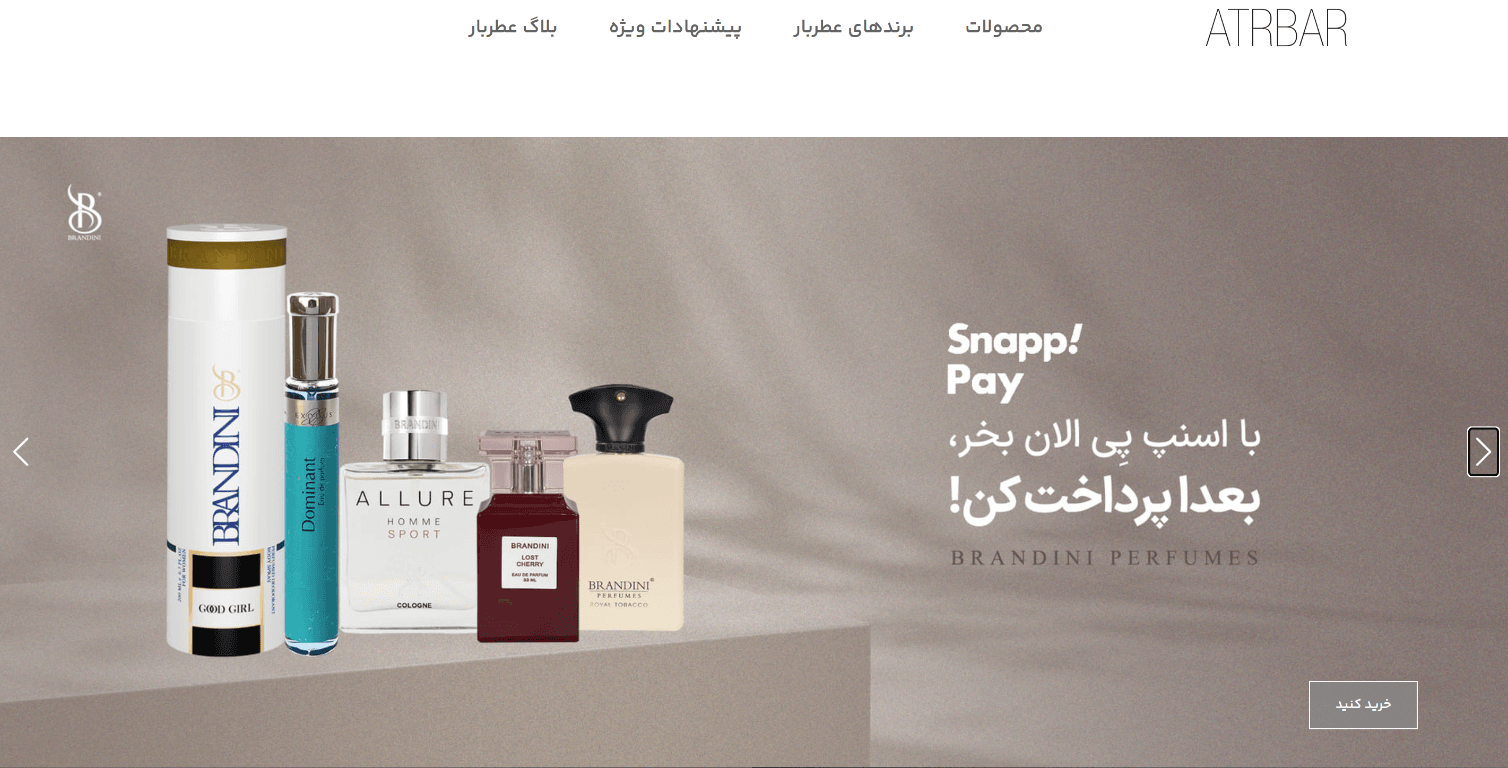
Brand presentation and promotional discovery
View 01 of 07
What I took from it
The best commerce experiences connect both sides of the screen.
A customer can experience a website as a simple sequence of clicks. Behind those clicks, however, the business needs information to move reliably between people, processes and systems. Atrbar reinforced the importance of understanding both sides: the experience customers see and the operational work that makes it possible.
Continue exploring